Computational fluid dynamics
Numerical simulation of turbulent internal and external flows, covering compressible and incompressible conditions.
- ANSYS Fluent
- ANSYS CFX
- OpenFOAM
CFD · Turbomachinery · Aerodynamics
CFD engineer focused on turbomachinery and aerodynamics. I use numerical simulation and flow analysis to investigate aerodynamic performance, understand loss mechanisms, and support engineering design.
01 · Profile
Fluid mechanics engineer focused on turbomachinery and aerodynamics, with experience in CFD workflows for compressible and incompressible flows, from geometry preparation and mesh generation to solver setup and post-processing.
My education at École Centrale Casablanca and Centrale Méditerranée, combined with training at Flowthermolab, brings together aerodynamics, mesh generation, RANS turbulence modelling, and scientific computing.
Numerical simulation of turbulent internal and external flows, covering compressible and incompressible conditions.
Geometry preparation and mesh generation for CFD, with a focus on turbomachinery flow passages.
Preliminary compressor design, rotor–stator modelling, and aerodynamic performance assessment.
RANS turbulence modelling, near-wall resolution assessment (y+), flow-field post-processing, and parallel computing.
02 / Selected engineering work
Three CFD studies from Flowthermolab’s Aerospace CFD Program. Explore my contribution and results, then open the technical details.
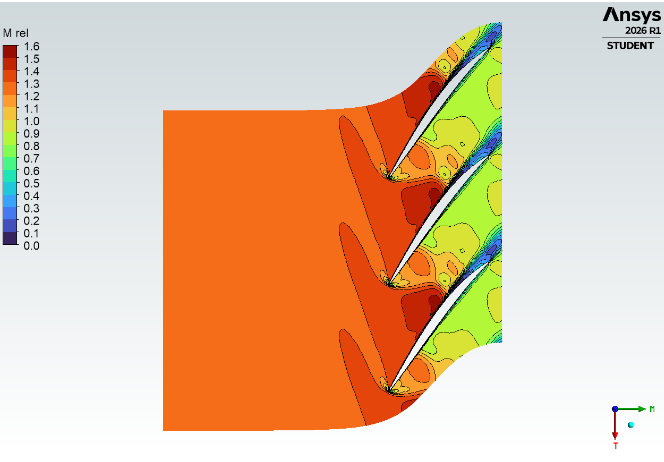
Compressible flow / Turbomachinery
ANSYS CFX · CFD-Post · 2026
Objective:
assess a transonic compressor’s performance.
My work:
simulated the rotor flow and analysed Mach distributions,
shock waves, blade-tip flow and aerodynamic losses.
Against NASA reference values: −2.74% in mass flow and −10.32% in pressure ratio. These differences remain part of the analysis.
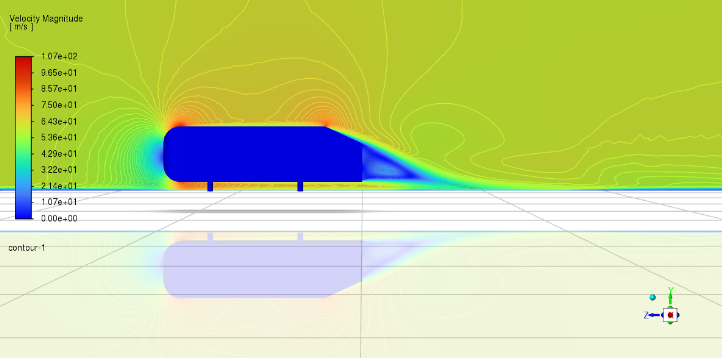
Incompressible flow / External aerodynamics
ANSYS Fluent · SpaceClaim · SST k–ω · 2026
Objective:
investigate separation, wake development and drag.
My work:
prepared the domain and locally refined mesh,
ran a steady RANS calculation and analysed the flow field.
Preliminary comparison with Tian et al. (2017). Geometry, coefficient definitions and mesh sensitivity require further investigation.
Compressor design / Internal flow
ANSYS Vista CCD · CFX · 2026
Objective:
connect impeller geometry to aerodynamic performance.
My work:
preliminary impeller design, mesh generation and CFD
analysis of pressure ratio, efficiency and losses.
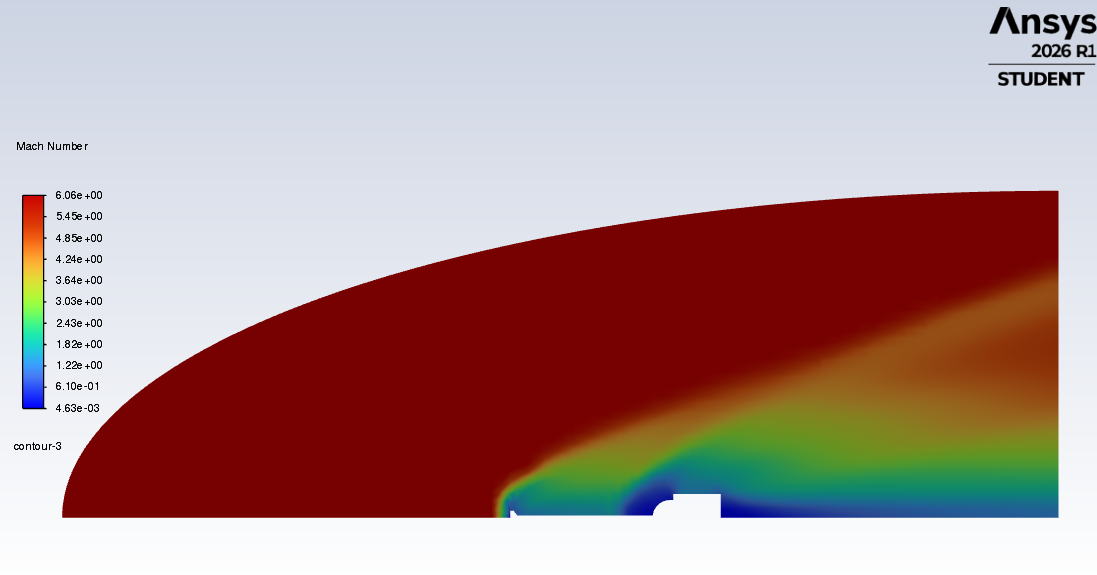
Compressible flow / External aerodynamics
ANSYS Fluent · RANS · SST k–ω · 2026
Objective:
explore compressible flow around a spiked blunt body
and understand how the spike modifies the shock system.
My work:
simulated the flow using the SST k–ω turbulence model
and interpreted Mach number, velocity and static
pressure contours.
Educational CFD study with a qualitative discussion based on Roveda (2009). Quantitative agreement and mesh independence have not been established.
03 · Experience
Research and engineering internships involving experimental fluid mechanics, scientific data analysis and energy systems.
Research objective: investigate how density differences affect turbulent jet behaviour and assess the applicability of constant-density models.
My contribution: processed PIV/PLIF data from air and helium jets using Python, analysed turbulence anisotropy and compared observations with similarity models. Also adapted a MATLAB optical model to study laser-sheet characteristics.

Research outputs: processed datasets, turbulence visualisations, comparisons with reference models and a technical internship report.
Processed and visualised PIV/PLIF datasets from air and helium jets at Reynolds numbers of 16,400 and 7,000. Used Python to analyse the measurements and compare jet behaviour with similarity models.
Analysed Reynolds stresses and turbulence anisotropy using invariants and the Lumley diagram. Investigated the directional structure of turbulent fluctuations in the measured jet flows.
Compared experimental observations with reference descriptions and assessed the applicability of a constant-density model to variable-density jets. Interpreted discrepancies in relation to the assumptions of the model.
Adapted an optical model to investigate laser-sheet thickness and depth at a wavelength of 532 nm. Explored lens spacing numerically for a target sheet thickness of 1 mm.
The optical work concerns numerical modelling. Experimental validation of the optical adjustments and a reduction in measurement noise are not claimed.
Investigation of AI-based approaches to photovoltaic plant performance optimisation. Analysis of solar tracker orientation and the effects of dust and UV radiation on energy performance.
04 · Education
Specialised training in CFD for aerospace and turbomachinery applications, covering compressible flows, mesh generation, numerical modelling, and aerodynamic performance analysis.
Advanced study in aerodynamics and fluid mechanics, with applications to aerospace and transport systems.
Multidisciplinary engineering education with a specialisation in fluid mechanics, energy systems, and numerical simulation.
Intensive two-year preparatory programme in mathematics, physics, and engineering sciences for competitive entrance examinations to engineering schools.
05 · Certifications
06 · Contact
Seeking a permanent CFD engineering role focused on turbomachinery, aerodynamics, or fluid flow simulation in the aerospace and energy sectors.
Based in France · Open to relocation across France · Available immediately